
- Federated C4ISR architectures enabling a near real-time Common Operational Picture (COP)
- Tactical data exchange via Link-11 (STANAG 5511) and Link-16 (STANAG 5516) across air, maritime and land forces
- Interoperability gateways integrating Link-11, Link-16, Link-22, SATCOM and IP tactical networks
- C2 data fusion architectures supporting operational decision-making and situational awareness
- Architecture aligned with NATO Architecture Framework (NAF) and STANAG interoperability standards
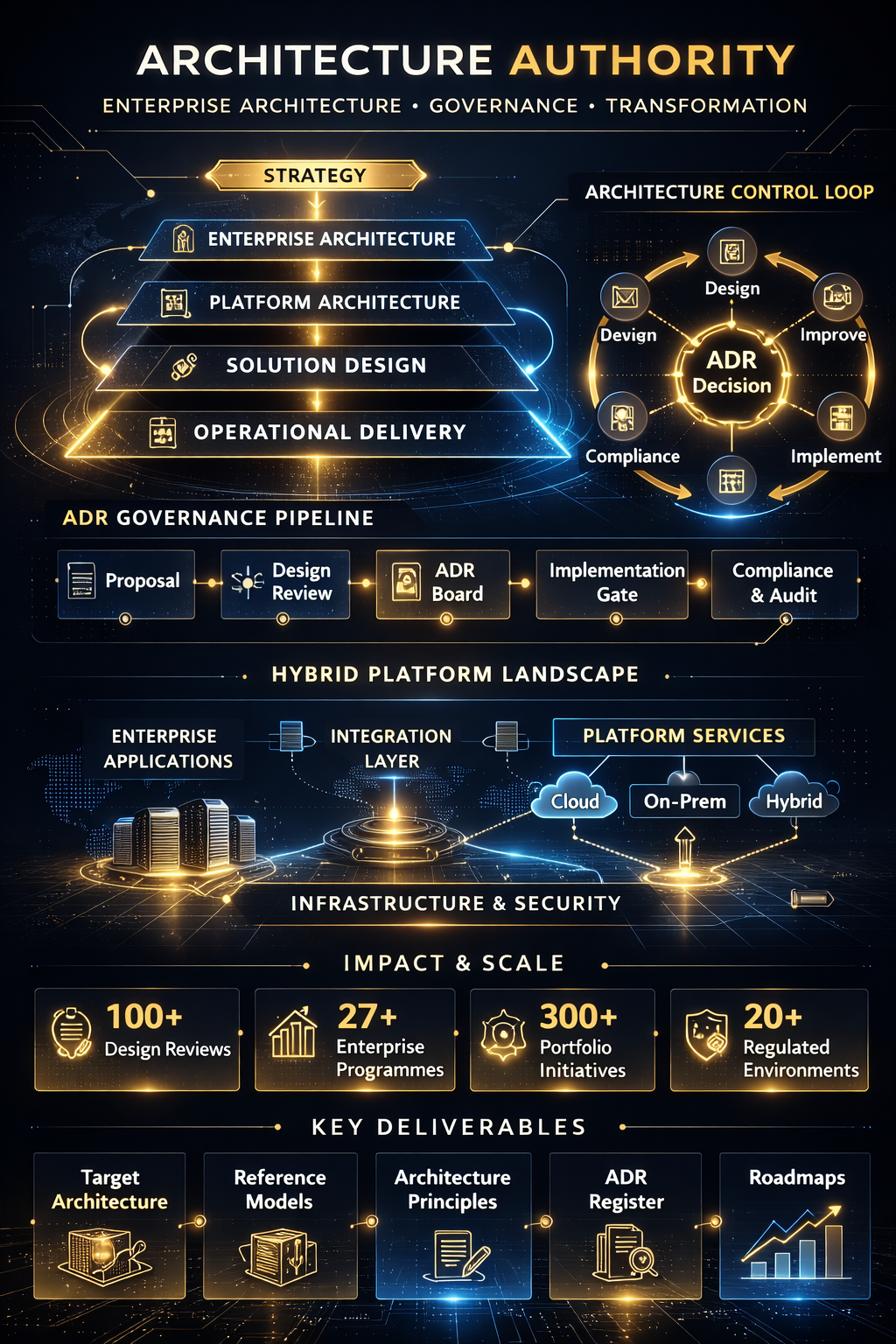
Architecture authority
Ensuring that strategy, platforms and delivery governance remain aligned across complex programmes, maintaining architectural coherence, traceable decisions and controlled change across regulated and mission-critical environments.
Institutional foundation
Built on architecture governance, programme delivery and security leadership across multinational and regulated environments, this approach treats architecture as a control discipline that enables change while limiting drift, fragmentation and unmanaged risk. It connects strategic intent, delivery structure, governance evidence and operational sustainability across complex institutions.
Architecture experience across institutions and industry
Experience spans enterprise architecture, target operating models, design governance, infrastructure modernisation, hybrid cloud alignment, interoperability, decision traceability and architecture-to-delivery execution across complex, regulated and high-trust environments.
Frameworks, certifications & executive education
Architecture & governance: TOGAF, ArchiMate, NAF, COBIT, ITIL, ISO-aligned governance principles, Agile / SAFe. Professional certifications: enterprise architecture, ITIL, PRINCE2, Certified Information Systems Auditor (CISA)-oriented audit practice, professional cybersecurity credentials. Executive education: Harvard learning in strategy, strategic thinking, strategy execution, innovation implementation, process improvement, crisis management, management and leadership.
Architecture authority across federated mission systems and regulated banking platforms
Target-state design, decision governance and execution-ready transformation patterns applied across high-trust environments.
- Enterprise architecture for regulated banking transformation
- Blockchain-enabled trust and traceability layers for regulated ecosystems
- Advanced AI models supporting fraud analytics and decision support
- Zero-trust and security-by-design patterns across hybrid cloud platforms
- Architecture scaling for institutions supporting 150,000+ users
This positioning shows how target-state design can remain strategic, evidence-led and operationally executable across defence and financial-service environments.
Strategic structure for complex digital estates
Architecture work establishes the target-state logic that links business priorities, operating models, platforms and delivery sequencing.
- Enterprise target architecture and domain architecture models
- Current-state to target-state transition roadmaps
- Business, application, data and technology alignment
- Architecture principles and design constraints
This work is particularly relevant for international organisations, banking, defence and large-scale institutional transformation.
Traceable technical decisions under executive constraint
Architecture authority depends on decision mechanisms that are reviewable, documented and enforceable across delivery teams.
- Architecture decision records (ADRs) and review boards
- Standards exceptions and controlled waivers
- Design review governance and quality gates
- Decision traceability across programme increments
These controls improve coherence, reduce rework and strengthen executive oversight in complex programmes.
Reducing fragmentation across large portfolios
Architecture must keep platforms interoperable, scalable and sustainable across hybrid and multi-vendor estates.
- Reference architectures and reusable patterns
- Integration and interoperability standards
- Shared service and platform rationalisation models
- Non-functional requirements for resilience and scalability
These capabilities help organisations modernise without losing operational continuity or architectural coherence.
Architecture connected to delivery reality
Architecture becomes valuable when it is tied directly to delivery structures, funding logic and operational ownership.
- Target operating models and capability maps
- Roadmap phasing linked to budget and delivery cadence
- RACI clarity for architecture and product governance
- Transition-to-operations design considerations
This keeps transformation anchored in practical execution rather than isolated design activity.
Architecture authority in regulated environments
Architecture leadership can support large institutional and regulated programmes where accountability, resilience and auditability are essential.
- International organisations and multilateral institutions
- Defence and mission-critical digital ecosystems
- Banking and financial services transformation
- Government and public-sector architecture modernisation
Across these environments, architecture must remain understandable to both technical teams and executive decision-makers.
Typical deliverables
Architecture authority produces practical artefacts that support decisions, investment oversight and controlled implementation.
- Target architecture blueprints and transformation architectures
- Architecture decision records and decision governance packs
- Standards catalogues and reference architecture patterns
- Roadmaps, transition states and capability maps
- Design authority review materials and exception logs
- Interoperability, resilience and non-functional architecture requirements
Architecture authority is most valuable when it keeps transformation legible, evidence-based and operationally sustainable from strategy through implementation.