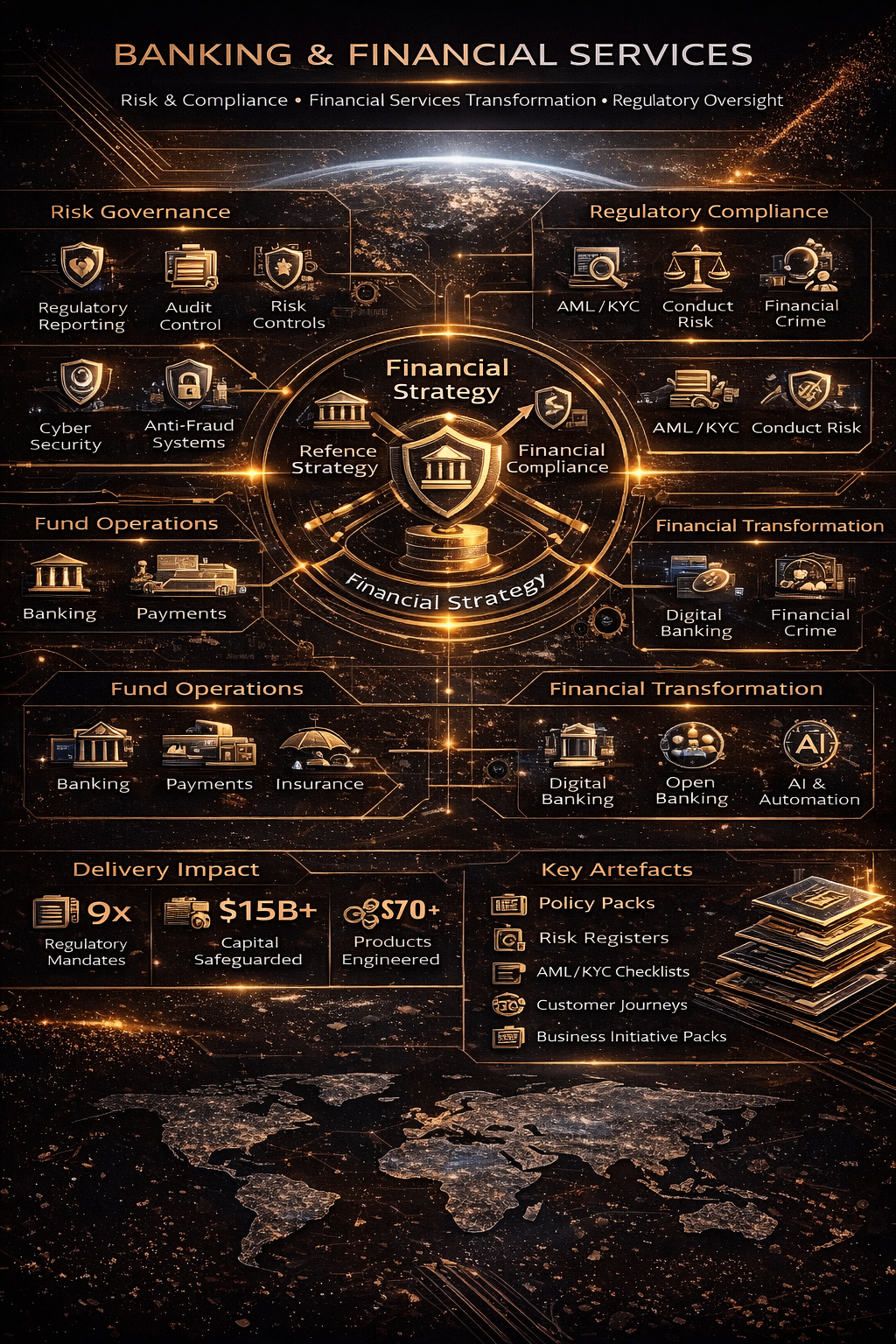
- Core banking platform modernisation and integration architectures
- Enterprise architecture alignment across business, application, data and technology domains
- Cybersecurity and regulatory control frameworks (ERC / GRC)
- Secure digital banking and transaction platforms
- Governance models supporting portfolio-scale transformation programmes
Banking & financial services
Designing secure banking architectures and governance models for regulated institutions, transaction platforms and transformation portfolios, using practices informed by enterprise architecture, cybersecurity, ERC/GRC, ITIL, PRINCE2, Agile / SAFe delivery models, portfolio management and control frameworks suited to continuously operating regulated environments.
Institutional foundation
Built on financial-sector architecture, governance and transformation experience, banking is approached as a tightly controlled ecosystem where platform decisions, regulatory obligations and service continuity must remain aligned.
Banking experience across institutions and industry
Experience built across regulated banking and financial-sector programmes, including work associated with Société Générale Group , UNFCU , the European Investment Bank , and broader enterprise architecture and governance work delivered through IBM and consulting-led transformation settings. Representative examples include core banking architecture, platform modernisation, risk and governance alignment, cybersecurity control design, delivery oversight and transformation support for continuously operating regulated environments.

Frameworks, certifications & executive education
Banking transformation & control: enterprise architecture governance, cybersecurity and ERC / GRC control models, Agile / SAFe delivery alignment, portfolio management, budgeting and financial-governance disciplines. Professional certifications: architecture, cybersecurity, ITIL, PRINCE2 and audit-aligned credentials. Executive education: Harvard learning in finance and accounting, strategic planning, strategy execution, risk management and management leadership.
Enterprise banking transformation architecture
Example architecture scope includes enterprise transformation across regulated banking environments, integrating core platforms, cybersecurity governance and operational delivery models.
Modernised banking platforms, improved regulatory defensibility and stable digital service delivery in continuously operating financial environments.
Modernising the institutional transaction backbone
Banking architecture work supports the systems at the heart of customer accounts, payments, products and financial processing.
- Core banking transformation and target-state design
- Platform integration across products, payments and customer data
- Modernisation pathways for legacy transaction estates
- Architecture coherence across enterprise banking domains
This is relevant for institutions modernising foundational banking platforms while preserving continuity and control.
Structuring change across complex financial institutions
Banking transformation requires clear enterprise architecture linking business capabilities, platform estates and delivery roadmaps.
- Enterprise architecture for regulated financial institutions
- Capability maps and transformation roadmaps
- Architecture governance for large banking portfolios
- Operating model alignment for business and technology change
These capabilities help banking institutions modernise coherently rather than through fragmented project-by-project change.
Control, resilience and regulatory defensibility
Financial institutions require controls that are strong technically and defensible from a governance, audit and regulatory perspective.
- Cybersecurity governance for banking environments
- ERC/GRC frameworks and control mapping
- Identity, segregation of duties and privileged control models
- Operational resilience and audit evidence structures
These controls support trust, supervision and resilience in environments where disruption or control failure has material consequences.
Customer-facing and specialist banking ecosystems
Banking estates often include digital channels, specialist applications and market-facing components that must remain integrated and controlled.
- Digital channels and alternative service architecture
- Trading and specialist banking application governance
- Customer journey alignment with backend platform logic
- Secure integration across front, middle and back-office domains
This helps institutions improve customer capability and specialist service performance without increasing uncontrolled complexity.
Banking transformation across regulated institutions
Banking and financial-services architecture can support institutions facing large-scale change, compliance pressure and modernisation demands.
- Retail, corporate and institutional banking contexts
- Core platform and digital banking transformation
- Risk, compliance and resilience-driven change programmes
- Multi-country or multinational regulated banking environments
Across these contexts, architecture must preserve trust, continuity and clear control evidence while enabling change.
Typical deliverables
Banking architecture and governance produce practical artefacts that support modernisation, regulation and operational continuity.
- Core banking target architectures and transformation roadmaps
- Enterprise architecture blueprints for financial institutions
- Cybersecurity, ERC/GRC and control-governance artefacts
- Digital channels, integration and operating-model designs
- Resilience, continuity and recovery architecture materials
- Decision records and governance packs for regulated change programmes
Banking transformation succeeds when platform modernisation, regulatory control and service continuity are treated as one integrated design problem.