NATO/NCIA · UN · UNDP · UNOPS · FREELANCING · EU · EEAS · IBM · ALCATEL/NOKIA · MOTOROLA
Data protection & DLPDefensible information governance

Data protection & DLP

Designing information governance models that protect sensitive data while supporting compliant operations, investigations and accountable digital transformation, using privacy-by-design, DLP, eDiscovery and lifecycle-control practices reinforced by GDPR-aligned data protection, ISO 27701 / ISO 27001-aligned privacy standards, cybersecurity, ITIL and governance certifications.

Institutional foundation

Built on data governance, privacy, security and eDiscovery-related experience, information protection is approached as a lifecycle discipline linking collection, access, retention, disclosure and evidence preservation.

Information governance experience across institutions and industry

Experience built across the United Nations system , UNOPS , IBM , regulated banking environments, and cross-border organisational settings where privacy, disclosure, retention and evidentiary control are operational requirements. Representative examples include privacy-by-design controls, DLP and eDiscovery readiness, lifecycle governance, defensible disclosure support and information handling models for sensitive, regulated and high-volume data environments.

Frameworks, certifications & executive education

Information governance & protection: GDPR (EU 2016/679), privacy-by-design, DLP, eDiscovery, lifecycle control, ISO 27701 / ISO 27001-aligned privacy practices, ITIL and governance-aligned operating practices. Professional certifications: data protection / GDPR, cybersecurity, ITIL and control-oriented credentials. Executive education: Harvard learning in risk management, process improvement and management disciplines relevant to defensible information governance.

Auto scroll →
20+
regulated or high-trust environments
15+
security / governance framework implementations with data protection relevance
300+
portfolio contexts informing information governance patterns
27+
enterprise programmes where data control and accountability mattered
10×
increase in data-protection inspection coverage (DPI) across enterprise information assets
95%
reduction in uncontrolled data-exposure risk through governance and protection controls
0
critical audit observations across mature information-governance reviews
Representative information governance architecture exampleEnterprise GDPR, DLP & eDiscovery architecture

Enterprise GDPR, DLP & eDiscovery architecture

Example scope includes enterprise information-governance and protection architecture across regulated digital ecosystems, connecting GDPR-aligned privacy engineering, DLP controls, retention logic and investigative readiness.

Typical architecture elements
  • GDPR-aligned privacy-by-design control patterns
  • Enterprise DLP architecture and sensitive-data governance
  • Retention, lifecycle and defensible disposal models
  • eDiscovery readiness, legal hold and evidence-chain governance
  • ISO 27701 / ISO 27001-aligned privacy and security operating practices
Outcome

Improved inspection coverage, defensible disclosure readiness and stronger control over sensitive information across regulated enterprise environments.

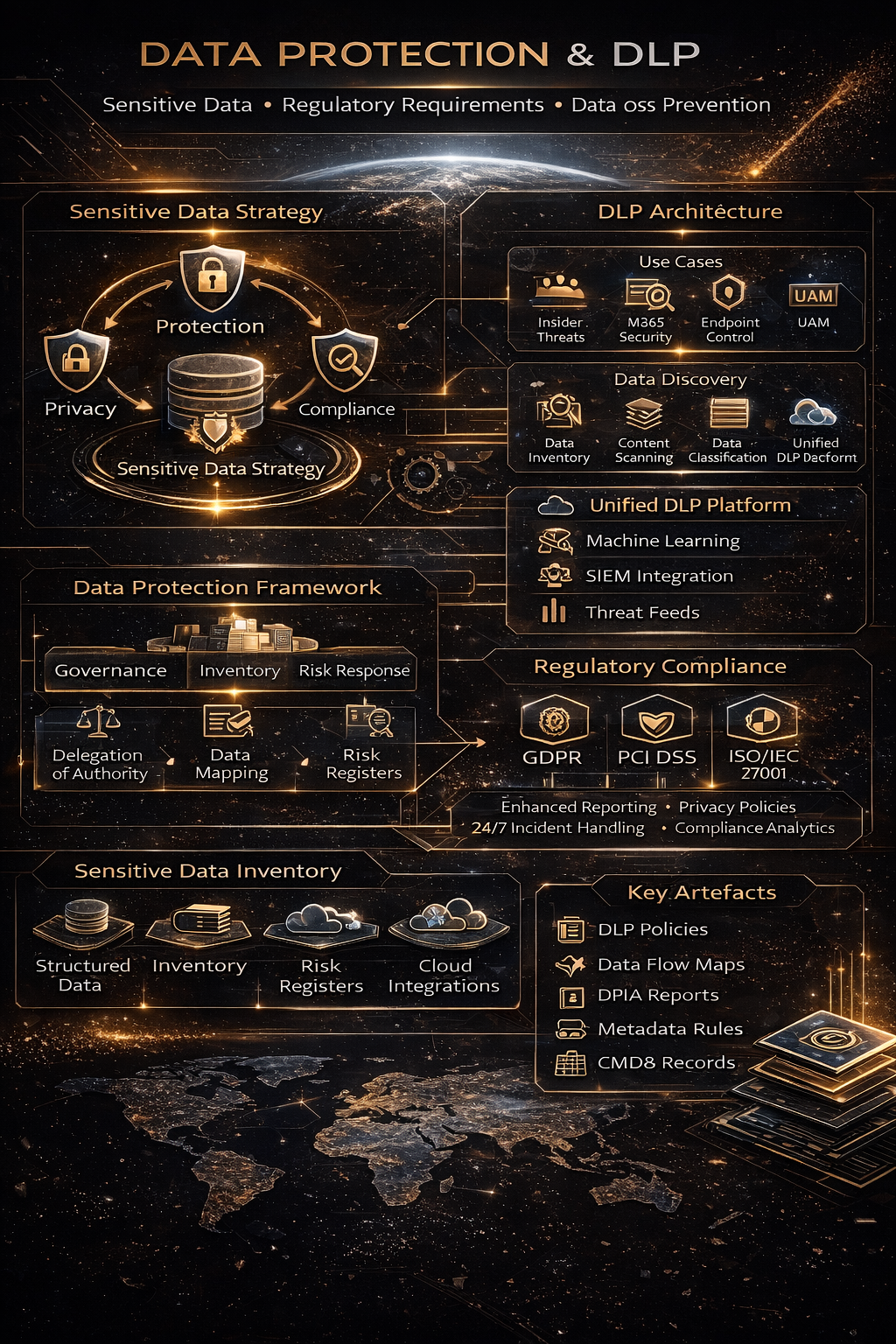
A4 strategic infographic summarising privacy-by-design, DLP architecture, retention governance, compliance, measurable scale and key information-protection artefacts.
Data protection & DLP infographic — executive A4 visual for web, briefings and PDF capability packs. A4 · high-tech · premium briefing style
Auto / manual scroll →
Privacy by design

Embedding protection into architecture and processes

Data protection is strongest when privacy requirements are integrated into systems, workflows and governance from the outset.

Typical focus areas include:
  • Privacy-by-design control patterns
  • Data minimisation and purpose limitation logic
  • Role-based access and data handling constraints
  • Governance checkpoints in project and change lifecycles

These capabilities are relevant wherever organisations process sensitive or high-volume information in regulated settings.

DLP & information control

Preventing loss, leakage and uncontrolled use

DLP and information governance controls help organisations protect sensitive data across endpoints, collaboration spaces and enterprise workflows.

Typical focus areas include:
  • DLP control frameworks and classification models
  • Information handling rules and policy enforcement
  • Cross-channel monitoring for sensitive data movement
  • Governance for exceptions and authorised disclosures

These controls improve defensibility in environments where data misuse or leakage can create significant legal or institutional risk.

Retention, lifecycle & records governance

Keeping information for the right reasons and no longer

Effective information governance requires clear retention logic linked to business, legal and operational needs.

Typical focus areas include:
  • Retention schedules and lifecycle governance
  • Records management alignment with digital workflows
  • Controlled deletion and defensible disposal processes
  • Legal hold and preservation readiness

This helps institutions balance accountability, operational efficiency and data minimisation obligations.

eDiscovery & investigative readiness

Preparedness for scrutiny, audit and legal review

When disputes, audits or investigations arise, organisations need information governance that supports defensible discovery and evidence handling.

Use cases include:
  • eDiscovery readiness and review workflows
  • Legal hold coordination and preservation controls
  • Collection and evidence-chain governance
  • Review structures for regulated investigations

These capabilities are especially important in banking, international organisations and complex governance environments.

Representative scope

Information governance in regulated environments

Data protection leadership can support organisations where trust, privacy and evidence handling are central to institutional credibility.

Representative scope includes:
  • International organisations and multilateral entities
  • Banking and regulated financial services
  • Government and public-sector digital services
  • Enterprise collaboration and high-volume information estates

Across these contexts, information governance must remain practical, reviewable and integrated with operations.

Typical deliverables

Data protection and DLP work produces operational artefacts that connect legal principles to real control environments.

  • Privacy-by-design patterns and data governance frameworks
  • DLP control models and sensitive-data handling rules
  • Retention schedules and lifecycle governance materials
  • eDiscovery readiness frameworks and legal-hold workflows
  • Policy-to-control mapping for information governance
  • Evidence packs for audits, investigations and compliance reviews

Information protection becomes credible when privacy, retention and evidence handling are built into day-to-day operations rather than treated as separate compliance layers.