NATO/NCIA · UN · UNDP · UNOPS · FREELANCING · EU · EEAS · IBM · ALCATEL/NOKIA · MOTOROLA
Cloud & platform engineeringHybrid / multi-cloud backbone

Cloud & platform engineering

Building resilient digital backbones across cloud, hybrid and platform environments that are designed for operations rather than experimentation alone, using practices informed by AWS, Azure and GCP governance models, ITIL, COBIT, resilience architecture patterns, DevOps coordination and Agile / SAFe delivery alignment.

Institutional foundation

Built on architecture governance, infrastructure modernisation and service delivery experience, platform engineering is approached as a long-term operational capability with clear guardrails for resilience, security and financial control.

Platform experience across institutions and industry

Representative examples include hybrid backbone modernisation, cloud and platform governance, interoperability design, resilience architecture, cost-control guardrails and service foundations designed for operations rather than pilots.

Frameworks, certifications & executive education

Platform engineering & cloud governance: AWS, Azure and GCP governance models, ITIL, COBIT, resilience architecture patterns, hybrid-cloud service delivery, DevOps coordination and Agile / SAFe delivery alignment. Professional certifications: cloud, architecture, service-management and cybersecurity credentials. Executive education: Harvard learning in strategy execution, process improvement, risk management and innovation implementation.

Auto scroll →
9x
AWS / Azure / GCP governance coverage
27+
enterprise programmes with platform and infrastructure dimensions
300+
portfolio projects across transformation estates
20+
regulated or high-trust environments
Representative platform architecture exampleUN OICT HQ hybrid cloud & digital workplace services

UN OICT HQ hybrid cloud & digital workplace services

Example scope includes hybrid-cloud service architecture and service-delivery management for digital workplace and collaboration services, reflecting institutional operating models similar to UN OICT HQ and section-head level coordination patterns seen in NATO / NCIA environments.

Typical architecture elements
  • Enterprise landing-zone architecture across AWS / Azure / GCP
  • Hybrid cloud integration across legacy, collaboration and workplace platforms
  • Digital workplace and collaboration service architecture with service-delivery governance
  • Observability, resilience and disaster-recovery architecture patterns
  • Cost governance, operational platform management and DevOps foundations integrated with scaled delivery models
Outcome

Operational digital platforms capable of supporting enterprise services with improved resilience, observability and governance, while strengthening digital workplace service quality across hybrid-cloud environments.

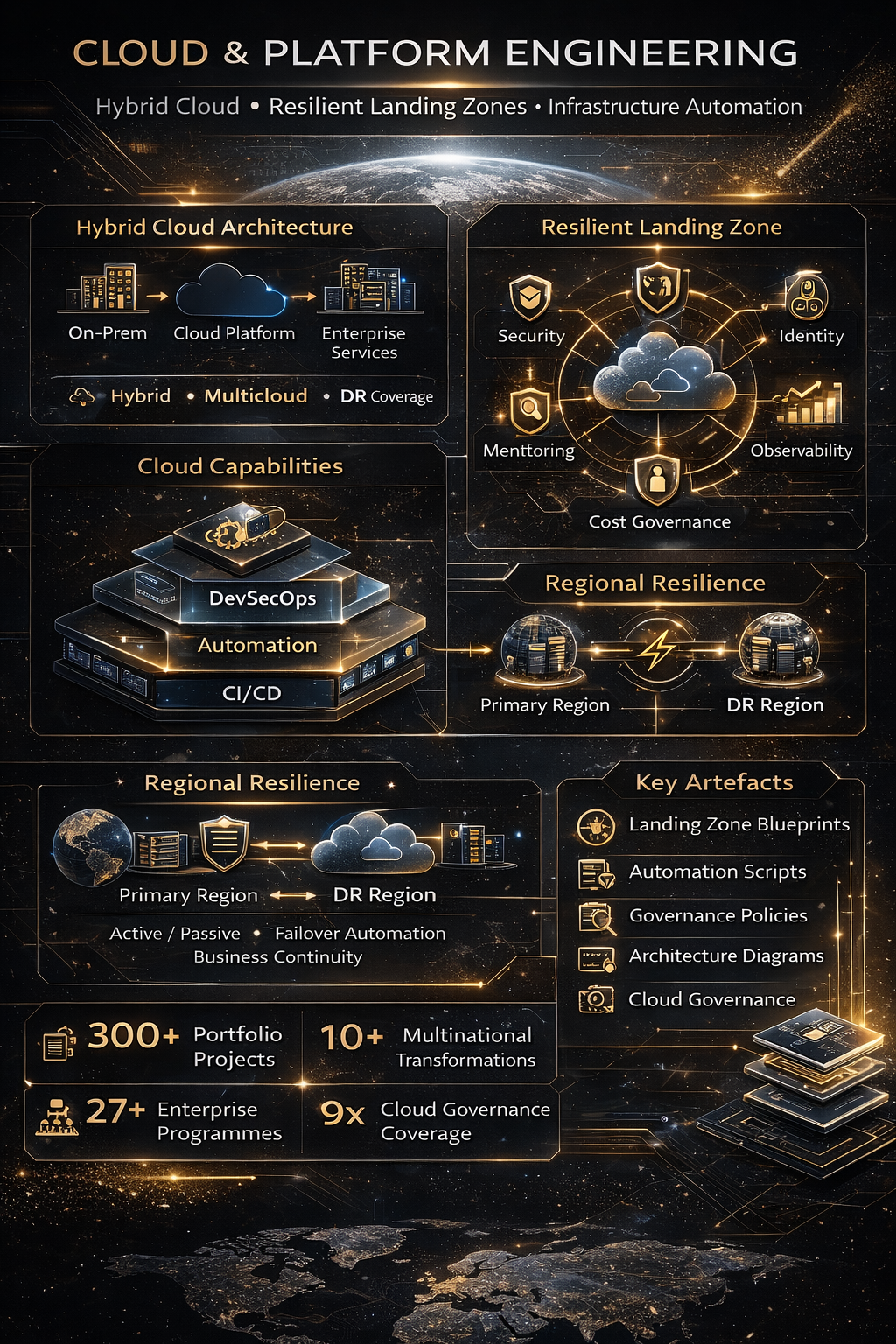
A4 strategic infographic summarising hybrid cloud architecture, landing-zone governance, resilience patterns, cloud operating capabilities, measurable scale and key platform artefacts.
Cloud & platform engineering infographic — executive A4 visual for web, briefings and PDF capability packs. A4 · high-tech · premium briefing style
Auto / manual scroll →
Landing zones & cloud foundations

Controlled starting points for scalable cloud adoption

Platform work establishes repeatable foundations so teams can move faster without compromising governance or resilience.

Typical focus areas include:
  • AWS, Azure and GCP landing-zone governance
  • Environment segmentation and account structures
  • Baseline networking, security and logging controls
  • Standardised platform guardrails for onboarding teams

These foundations reduce ad hoc cloud growth and make enterprise adoption more consistent and controllable.

Hybrid backbone modernisation

Connecting legacy and modern platforms

Many organisations need platforms that bridge on-premise estates, cloud services and mission-critical legacy dependencies.

Typical focus areas include:
  • Hybrid integration and service connectivity models
  • Backbone modernisation sequencing
  • Platform dependency mapping and transition planning
  • Operations-ready service foundations

This is particularly relevant for multinational institutions, financial platforms and critical infrastructure environments.

Resilience, observability & recovery

Keeping platforms measurable and recoverable

Operational platforms must be observable, recoverable and resilient under stress, failure or regional disruption.

Typical focus areas include:
  • Regional DR and resilience patterns
  • Monitoring, logging and observability models
  • Service health indicators and operational dashboards
  • Recovery objectives and continuity design

These capabilities help organisations move from infrastructure deployment to dependable service operation.

Cost governance & platform accountability

Cloud economics with executive visibility

Cloud and platform scale require explicit cost governance, ownership models and usage transparency.

Use cases include:
  • Cost allocation and tagging governance
  • Platform ownership and FinOps-aligned controls
  • Consumption visibility and anomaly monitoring
  • Executive reporting on platform cost drivers

This helps keep digital backbone modernisation sustainable over time.

Representative scope

Platform engineering for operational institutions

Platform leadership can support enterprises that need secure, resilient and efficient digital foundations across complex environments.

Representative scope includes:
  • International organisations and shared services
  • Banking and regulated platforms
  • Government and mission-critical digital estates
  • Critical infrastructure and multi-site operations

Across these settings, platforms succeed when they are engineered for governance, continuity and measurable operations.

Typical deliverables

Cloud and platform engineering produces operational artefacts that support scale, resilience and controlled adoption.

  • Landing-zone blueprints and platform guardrail models
  • Hybrid architecture patterns and transition roadmaps
  • Resilience, DR and observability design packs
  • Service foundations and operational readiness models
  • Cost governance frameworks and platform ownership structures
  • Reference patterns for secure, scalable cloud adoption

Cloud and platform engineering creates value when infrastructure is translated into reliable service foundations with visible control, resilience and cost discipline.