NATO/NCIA · UN · UNDP · UNOPS · FREELANCING · EU · EEAS · IBM · ALCATEL/NOKIA · MOTOROLA
Defence & intelligenceC4ISR · secure cloud · mission systems

Defence & intelligence

Designing mission-critical architectures and governance models for defence organisations, intelligence environments and secure governmental operations, using practices aligned with NAF, STANAG interoperability standards, secure-network architecture principles and certifications spanning cybersecurity, architecture, ITIL and programme governance.

Institutional foundation

Built on experience across NATO-related, governmental and high-security environments, defence architecture is approached through mission continuity, assurance discipline, interoperability and controlled operational execution.

Defence and intelligence experience across institutions and industry

Representative examples include C4ISR-aligned architecture thinking, secure digital infrastructure, mission-support platforms, interoperability models, operational resilience and governance for high-security service environments.

Frameworks, certifications & executive education

Mission architecture & interoperability: NAF, STANAG interoperability standards, secure-network architecture principles, risk management and controlled programme governance for mission-critical environments. Professional certifications: architecture, cybersecurity, ITIL and programme-governance credentials. Executive education: Harvard learning in crisis management, strategic planning and risk management relevant to high-trust operational environments.

Auto scroll →
10+
multinational transformation programmes
20+
high-trust or regulated environments
100+
formal design reviews contributing to control and interoperability
Full
lifecycle orientation from architecture to operations
Representative architecture delivery exampleFederated C4ISR mission architecture

Federated C4ISR mission architecture

Example scope includes the design and governance of federated operational architectures connecting sensors, operational platforms and command centres to create a Common Operational Picture (COP) across multinational environments, complemented by NATO / NCIA-style section-head service delivery management for digital workspace and collaboration services supporting mission users.

Typical architecture elements
  • Tactical data exchange via Link-11 (STANAG 5511) and Link-16 (STANAG 5516)
  • Interoperability gateways integrating Link-11 / Link-16 / Link-22 / SATCOM / IP tactical networks
  • C2 platforms enabling data fusion and operational decision support
  • Mission architectures aligned with NAF – NATO Architecture Framework
  • Service-delivery management for digital workspace / collaboration services in high-trust operational contexts
Outcome

Improved situational awareness, coordinated command decisions and resilient mission execution across joint environments, supported by dependable collaboration and workplace services for mission users.

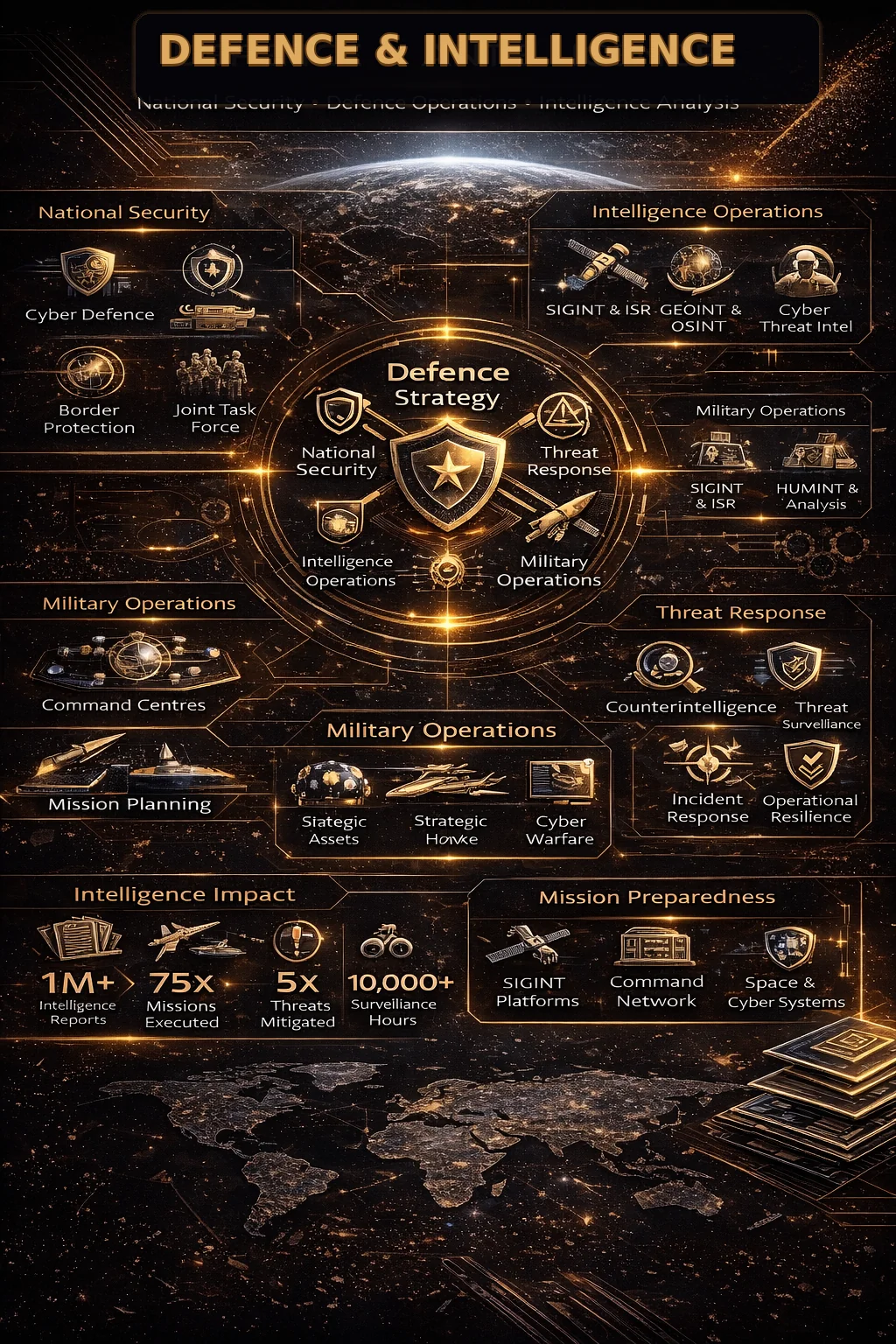
A4 strategic infographic summarising C4ISR, secure cloud, mission systems, intelligence workflows, resilience patterns and key defence artefacts.
Defence & intelligence infographic — executive A4 visual for web, briefings and PDF capability packs. A4 · high-tech · premium briefing style
Auto / manual scroll →
C4ISR & mission systems

Operational architectures for command environments

Mission systems require disciplined integration across communications, data, applications, infrastructure and operational workflows.

Typical focus areas include:
  • C4ISR architecture and service integration
  • Command support platforms and operational workflows
  • Mission data exchange and interoperability patterns
  • Operational governance for critical service environments

These capabilities support complex defence organisations where service interruption or fragmentation directly affects mission performance.

Secure governmental cloud

Protected digital foundations for sensitive operations

Defence and governmental environments increasingly require cloud and hybrid capabilities with explicit security, resilience and sovereignty controls.

Typical focus areas include:
  • Private and hybrid cloud architecture for secure environments
  • Protected service foundations and segmentation models
  • Resilience and recovery for critical digital services
  • Governance for sensitive workloads and operational access

These architectures help extend modern digital capability into environments with high assurance requirements.

Intelligence applications & situational awareness

From information flows to operational insight

Intelligence-supporting architectures must turn distributed data into timely, governed and mission-relevant awareness.

Typical focus areas include:
  • Situational awareness platforms and information fusion
  • Image recognition and AI-supported analytical components
  • Secure intelligence workflows and controlled dissemination
  • Sensor, operational and cyber data integration

This supports organisations that need faster insight without compromising control over sensitive information.

Cyber defence & resilient operations

Security embedded into mission continuity

Mission environments require cyber governance and resilience patterns that preserve operational trust during disruption, attack or degradation.

Use cases include:
  • Cyber defence governance and assurance patterns
  • Secure communications and identity controls
  • Continuity planning for mission-critical platforms
  • Operational monitoring and intervention pathways

This keeps security connected to mission assurance rather than isolated as a separate technical layer.

Representative scope

Defence architecture across high-trust ecosystems

Defence and intelligence support can extend across multiple institutional and operational environments where resilience and sovereignty are essential.

Representative scope includes:
  • NATO-related and allied mission environments
  • Governmental secure cloud and protected digital services
  • Intelligence, surveillance and situational awareness platforms
  • Critical operational infrastructures with strict assurance needs

Across these contexts, architecture must balance mission speed with control, resilience and interoperability.

Typical deliverables

Defence and intelligence architecture produces practical artefacts that guide mission systems, security and resilient delivery.

  • Mission architecture blueprints and interoperability models
  • Secure cloud and protected-platform design patterns
  • Operational governance packs for mission services
  • Situational awareness and intelligence workflow architectures
  • Cyber defence governance and assurance materials
  • Resilience, continuity and recovery design artefacts

Defence architecture creates value when mission systems remain secure, interoperable and operationally dependable under real-world constraint.