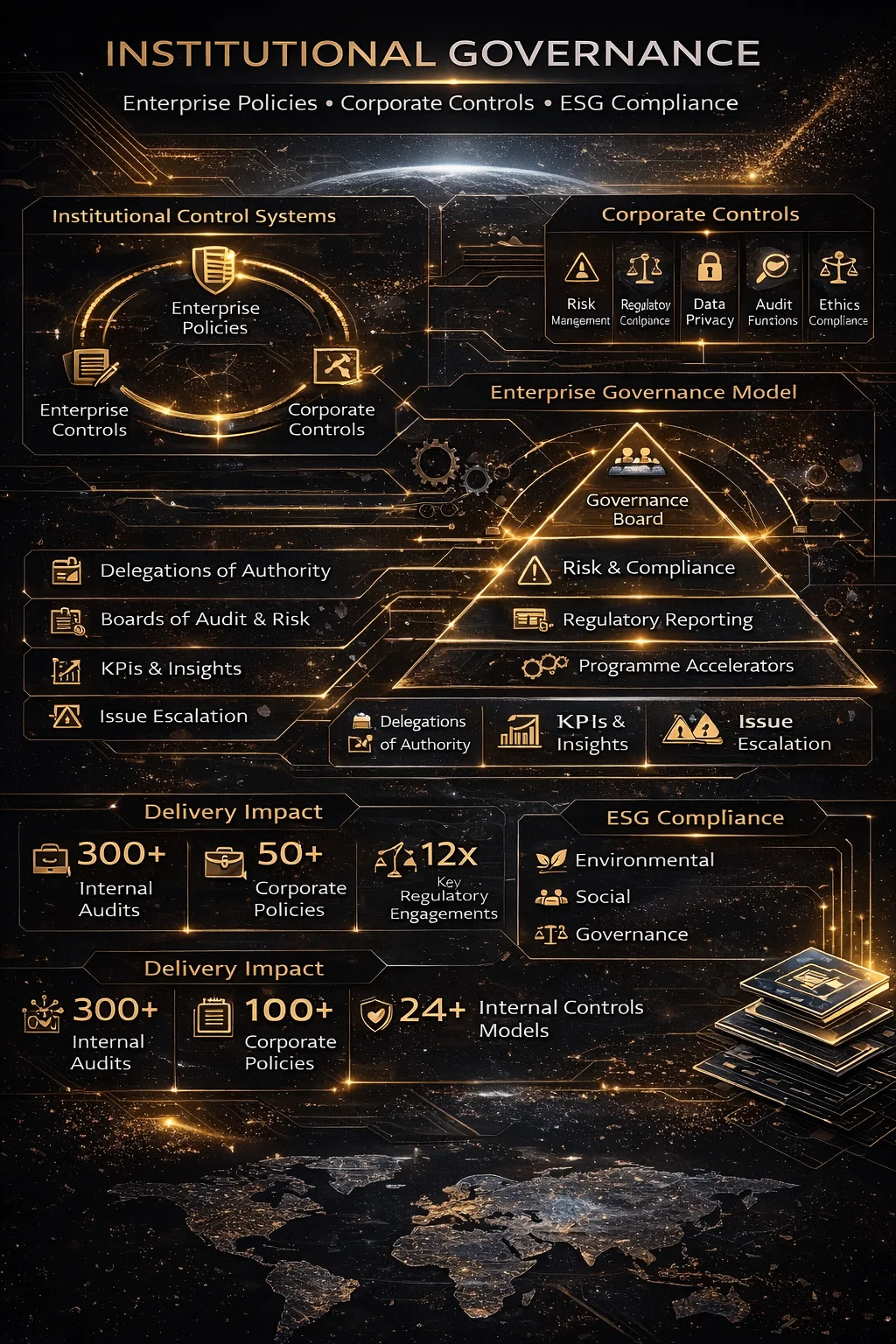
- Governance execution models linking mandate, decision rights and workflows
- KPI structures for accountability, reform tracking and intervention visibility
- Portfolio-level oversight packs, escalation logic and evidence-led reporting
- Policy-to-execution mapping across business, technology and control functions
- Institutional reform diagnostics informed by GARI governance patterns
Institutional governance
Designing governance frameworks that keep digital transformation accountable, reviewable and aligned to institutional mandate, using governance models informed by COBIT, ITIL, ISO-aligned control practices, ADR-style traceability, Agile / SAFe delivery governance and recognised governance, project and service-management certifications.
Institutional foundation
Built on governance advisory, architecture control and programme leadership in multinational and regulated environments, governance is approached as an execution framework that makes authority visible, reviewable and sustainable over time.
Governance experience across institutions and industry
Representative examples include governance design, accountability structures, decision-rights mapping, oversight models, control alignment and execution frameworks for multinational, public-sector and high-trust environments, including GARI-oriented governance execution models with measurable KPI structures for institutional clarity and reform tracking.
Frameworks, certifications & executive education
Governance & control: COBIT, ITIL, ISO-aligned control practices, ADR-style traceability, Agile / SAFe delivery governance, portfolio oversight and accountable decision structures. Professional certifications: governance, project, service-management and audit-aligned credentials including CISA-oriented practice. Executive education: Harvard learning in strategic thinking, strategy execution, crisis management, change control, management and leadership, mentoring and strategic planning. Institutional reform context: GARI governance execution models with KPI-led oversight, accountability mapping and reform diagnostics.
GARI governance execution framework with KPIs
Example scope includes governance execution architecture designed to make accountability, intervention pathways and institutional performance visible through KPI-led oversight and reform diagnostics.
Improved governance visibility, clearer accountability chains and KPI-based leadership oversight across complex institutional environments.
Making institutional authority operational
Governance work establishes how decisions are taken, who is accountable and how oversight is exercised across programmes and platforms.
- Governance models and decision-rights mapping
- Committee structures and escalation pathways
- Role clarity, accountability and RACI logic
- Mandate-aligned execution frameworks
These capabilities support institutions where fragmented authority would otherwise weaken delivery and oversight.
From governance design to defensible control
Governance must enable leaders to understand risks, interventions and control effectiveness across complex portfolios.
- Risk registers and oversight dashboards
- Control ownership and review cycles
- Policy-to-execution traceability
- Exception handling with accountable approvals
This helps institutions move from abstract policy statements to reviewable governance practice.
Connecting leadership decisions to operational reality
Institutional governance is strongest when strategic decisions can be traced into programme structures, delivery teams and measurable outputs.
- Decision instruments and review packs
- Portfolio-level oversight and intervention models
- Execution alignment across business, technology and operations
- Evidence-led reporting for leadership forums
Such alignment is particularly important in multilateral, governmental and highly regulated environments.
Governance for modern service environments
Digital institutions need governance that supports security, resilience, data control and service continuity across changing technology landscapes.
- Digital policy implementation models
- Governance for cloud, data and cyber domains
- Operational resilience and continuity oversight
- Integrated governance across architecture, delivery and risk
This allows transformation to progress without weakening institutional trust or control.
Governance across complex institutional systems
Governance leadership can support institutions facing structural complexity, cross-functional dependencies and high expectations of accountability.
- International organisations and multilateral agencies
- Government and public administration reform contexts
- Enterprise and portfolio-level transformation governance
- Regulated industries requiring resilient oversight
Across these contexts, governance must remain practical, comprehensible and capable of guiding action under constraint.
Typical deliverables
Institutional governance generates decision-ready artefacts that support oversight, accountability and disciplined execution.
- Governance frameworks, charters and decision-rights models
- Risk oversight dashboards and control review materials
- Decision instruments, review packs and escalation pathways
- Portfolio governance structures and intervention models
- Policy-to-execution traceability maps
- Integrated governance models across architecture, cyber and delivery
Institutional governance creates trust when authority is documented, responsibilities are clear and oversight remains connected to operational reality.