NATO/NCIA · UN · UNDP · UNOPS · FREELANCING · EU · EEAS · IBM · ALCATEL/NOKIA · MOTOROLA
Innovation & ArchitectureEmerging technologies for mission-critical environments

Innovation & Architecture

Designing mission-critical digital systems and transformation architectures for resilient, scalable and operational environments, using practices informed by enterprise architecture standards, secure-by-design principles, AI governance, post-quantum readiness, ITIL, PRINCE2 and architecture-related certifications.

Institutional foundation

Built on a solid foundation of international certifications, architecture governance and delivery experience, innovation is approached as an operational discipline rather than a technology trend. This includes designing architectures that integrate emerging technologies while remaining secure, auditable and sustainable across complex institutional and regulated environments.

Innovation experience across institutions and industry

Experience built across IBM , NATO / NCIA-related environments , the United Nations system , telecom groups including Alcatel , Nokia and Motorola , and innovation-led platform work in regulated environments. Representative examples include AI-enabled operational intelligence, blockchain trust models, sensor-driven awareness, innovation architecture, secure experimentation, DLP-aware information governance and translating emerging technology into controlled delivery contexts, including PIR2-IT prototypes and delivery patterns.

Frameworks, certifications & executive education

Innovation & controlled experimentation: enterprise architecture standards, secure-by-design principles, AI governance, DLP-aware information handling, ITIL, PRINCE2 and architecture-related certifications. Executive education: Harvard learning in entrepreneurship essentials, innovation implementation, strategic thinking, strategy execution and process improvement. PIR2-IT relevance: AI-enabled operational intelligence, sensor fusion, trust architecture and controlled data-governance patterns.

Auto scroll →
300+
portfolio initiatives informing innovation and delivery patterns
27+
enterprise programmes across complex environments
20+
regulated or high-trust contexts informing innovation guardrails
10+
multinational transformations relevant to scaled adoption
AI
PIR2-IT operational intelligence, analytics and sensor-fusion patterns
DLP
controlled information-handling patterns embedded into innovation design
Representative innovation architecture examplePIR2-IT AI intelligence & controlled data innovation

PIR2-IT AI intelligence & controlled data innovation

Example scope includes AI-enabled operational intelligence, controlled experimentation and DLP-aware information handling patterns developed through PIR2-IT innovation work across secure and regulated contexts.

Typical innovation elements
  • AI-enabled operational analytics and decision-support patterns
  • Sensor fusion, situational awareness and secure experimentation models
  • DLP-aware information governance embedded into data flows
  • Blockchain-based trust, traceability and integrity mechanisms
  • PIR2-IT delivery patterns linking innovation to architecture governance
Outcome

Innovation environments that improve operational insight while preserving control over sensitive data, trust architecture and deployment discipline.

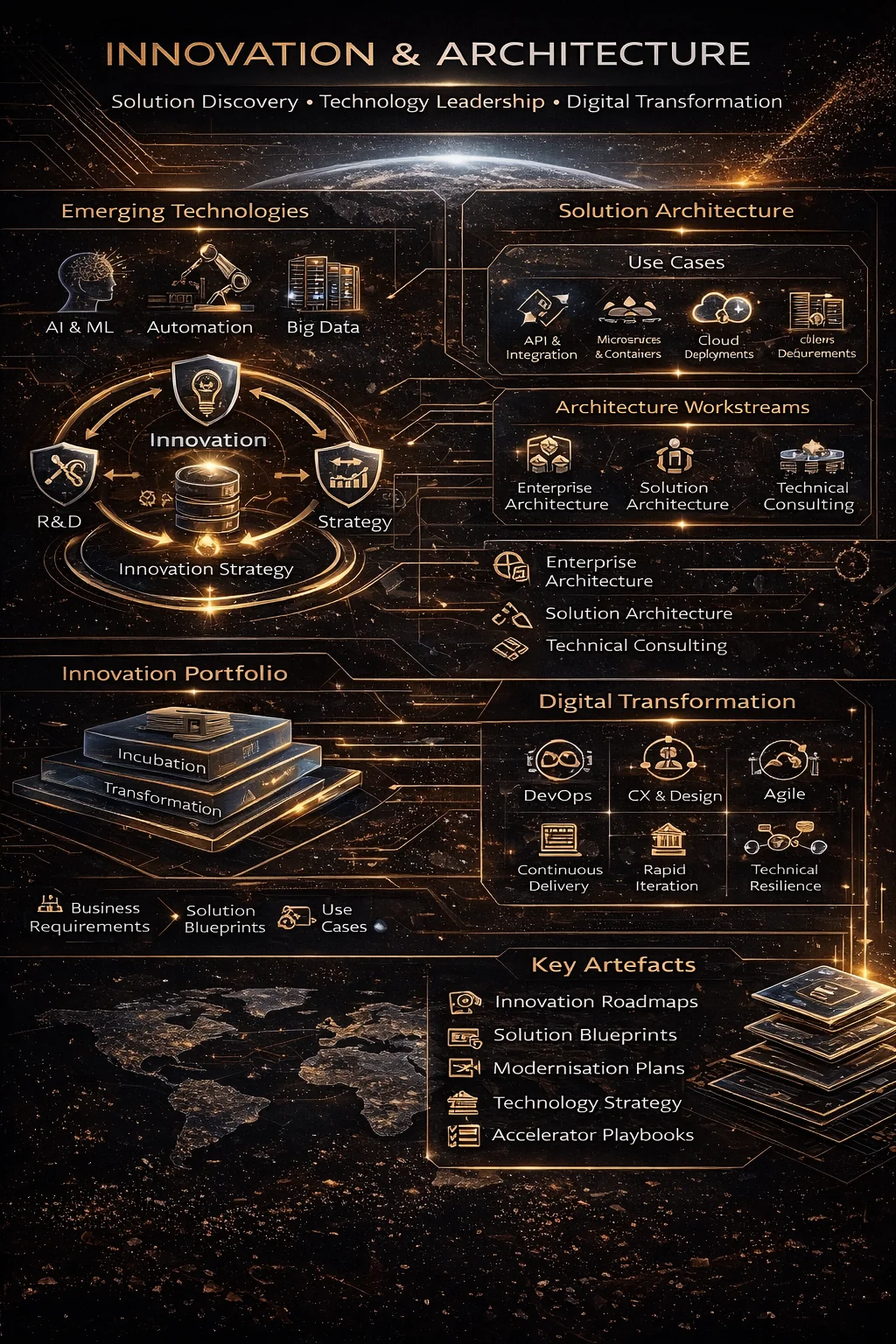
A4 strategic infographic summarising innovation strategy, AI, blockchain, quantum strategy, post-quantum readiness, solution architecture, digital transformation and key innovation artefacts.
Innovation & architecture infographic — executive A4 visual covering AI, blockchain, quantum strategy, post-quantum readiness, digital transformation and mission-critical architecture. A4 · high-tech · premium briefing style
Auto / manual scroll →
Artificial intelligence & intelligent systems

Operational intelligence and decision support

Artificial intelligence can enhance operational insight, automation and decision support across complex digital environments.

Typical applications include:
  • AI-supported operational analytics
  • Predictive incident intelligence
  • Automation of complex operational workflows
  • Decision-support systems for governance and risk management

These capabilities are particularly relevant in banking operations, defence environments and public sector digital services.

Institutional governance supported by AI

Governance, traceability and control evidence

AI can strengthen institutional governance frameworks by improving traceability, oversight and control evidence.

Examples include:
  • Compliance monitoring and policy enforcement
  • Automated evidence collection for audits
  • Risk analytics and governance dashboards
  • Decision traceability for complex programmes

Such capabilities support government institutions, international organisations and regulated industries where transparency and accountability are critical.

Blockchain & trusted digital infrastructures

Digital trust, traceability and integrity

Distributed ledger technologies can enable trusted digital ecosystems where integrity and traceability are essential.

Applications include:
  • Trusted digital identity frameworks
  • Secure inter-organisation data exchange
  • Tamper-evident audit trails
  • Integrity assurance for institutional workflows

These technologies can support financial systems, cross-border government services and regulated institutional environments.

Autonomous sensing, drones & operational intelligence

Operational intelligence in physical environments

Drone platforms and sensor networks extend digital architectures into physical operational environments.

Use cases include:
  • Infrastructure monitoring
  • Border and environmental sensing
  • Asset inspection and operational intelligence
  • Real-time situational awareness

When integrated with digital platforms and analytics systems, these technologies support defence, security, infrastructure management and public sector operations.

Quantum strategy & post-quantum readiness

Strategic readiness for emerging computational risk

Quantum and post-quantum developments matter where long-term cryptographic resilience, optimisation potential and future technology planning must be assessed without weakening present-day control.

Typical focus areas include:
  • Quantum strategy, post-quantum readiness and transition awareness
  • Governance for cryptographic resilience and long-horizon security risk
  • Strategic technology assessment for quantum-ready architectures
  • Controlled experimentation for future computational capabilities

This supports institutions that need a disciplined view of emerging computational change across security, architecture and innovation portfolios.

Sector applicability

These innovation capabilities can support transformation in sectors such as:

  • Banking & financial services
  • Defence and security environments
  • Government and public administration
  • International organisations
  • Critical infrastructure and regulated industries

Architectures with innovative technologies

Architecture work includes the integration of innovative technologies such as artificial intelligence, blockchain-enabled trust models, AI-supported institutional governance, quantum strategy, post-quantum readiness, autonomous sensing, drone-enabled operational intelligence and interoperable digital ecosystems. These architectures are designed to support secure transformation in banking, defence, government, international organisations and other regulated sectors.

Typical architecture & innovation deliverables

Innovation and architecture work results in concrete delivery artefacts that guide transformation programmes, technology decisions and operational implementation.

  • Target architecture and transformation architecture blueprints
  • Architecture decision records (ADRs) and decision governance frameworks
  • Technology innovation assessments and architecture roadmaps
  • AI-enabled operational analytics and automation design patterns
  • Blockchain-based trust and integrity architecture concepts
  • Sensor, drone and operational intelligence integration architectures
  • Digital ecosystem and interoperability architecture models
  • Post-quantum readiness assessments and governance models for emerging computational risk
  • Governance, risk and compliance architecture integration
  • Operational architecture for resilient digital platforms

Emerging technologies become valuable only when embedded within secure architectures, governance frameworks and operational delivery models that allow organisations to innovate while maintaining resilience, accountability and institutional trust.